As December progresses and daylight grows scarce, many of us feel the need to follow the rhythms of nature and slow down. This slowing allows us to listen more closely and tend the quiet places within ourselves. As we approach the longest night of the year, we invite you into an ancient, storied practice of reflection and hope: the Advent Spiral.
On Sunday, December 21, our Advent Spiral will be open open-house style from 2:00–7:00 pm, offering space to come when you are able and linger as long as you wish. You are invited to engage with three reflection stations: Waiting, Releasing, and Lifting, each offering scripture and poetry as companions for prayer, contemplation, and response. Then, take time to walk the spiral at your own pace, or use the finger labyrinth if you prefer.
The Advent Spiral is inspired by Waldorf tradition, where seasonal festivals help children and adults experience time not as something rushed, but as something lived through the body, the senses, and the natural world. Marking seasonal change helps us notice the movement of the sun and the deep rhythms of the earth, while cultivating gratitude for creation, community, and the quiet light that dwells within each of us. This way of moving through the season resonates deeply with the Christian season of Advent, a time marked by waiting. Advent invites us to slow down, to watch and listen, and to practice hope in the dark. Like the inward path of the spiral, Advent calls us into stillness and expectation, trusting that God’s light is already at work, even when the world feels dim. The journey toward the center mirrors our longing for Christ, the Light of the World, born not in spectacle, but in humility and love.
In Waldorf and Montessori communities, this time of year is often called the Season of Light or Winter Light Festivals, honoring sacred observances such as Advent, Hanukkah, Diwali, Kwanzaa, Yalda, and Christmas. Though distinct, these traditions share a common truth: when darkness feels longest, we kindle light. Candles are lit, stories are told, and communities gather to proclaim that hope endures, and love does not go out. Our spiral walk honors both our Christian practice of Advent and this wider season of light. In the Christian tradition, the longest night has long been understood as holy ground. A threshold where grief, waiting, and hope are held together, and where the promise of Christ’s light is proclaimed precisely when darkness feels deepest. This is not a replica of a Waldorf ceremony, but a practice shaped for our community—rooted in hope, open in spirit, and welcoming of all ages and backgrounds.
Additionally, a spiral is one of nature’s enduring patterns, found in shells, pinecones, flowers, and galaxies. Across cultures, it symbolizes time, rebirth, pilgrimage, and spiritual journey. In the Advent Spiral, the form itself becomes prayer. As we walk inward, we trace the arc of the year as light diminishes, and the world grows quieter. At the center—the deepest point of the season—we pause not in despair, but in holy expectancy, remembering that divine light is entrusted to the world in humility and love. From there, we turn outward again, carrying what we have received back into the world, attentive to the small ways light is growing.
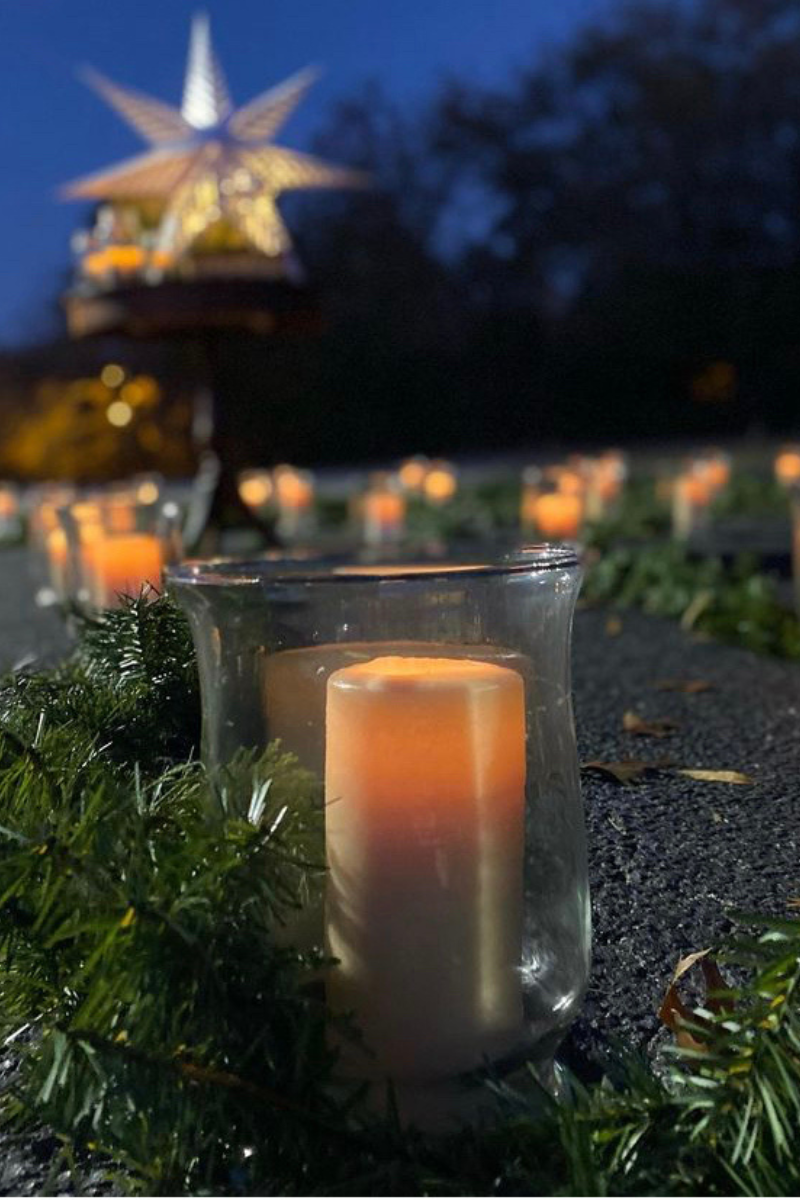
Traditionally, children walk the spiral in silence, carrying a candle toward a single flame. As each light is placed along the path, darkness slowly fills with glow. In our spiral, we use luminaries—gentle points of light that remind us love is ever-present, even when hard to see. The garland forming our spiral calls evergreens to mind, symbols of resilience and life that endures through winter.
The Advent Spiral is both deeply personal and quietly communal. It is a place of connection to the earth’s rhythms, to ancient wisdom, to one another in shared silence, and to the steady hope that even now, light is being born again.
We invite you to come, to walk, to pause, and to carry the Light forward.