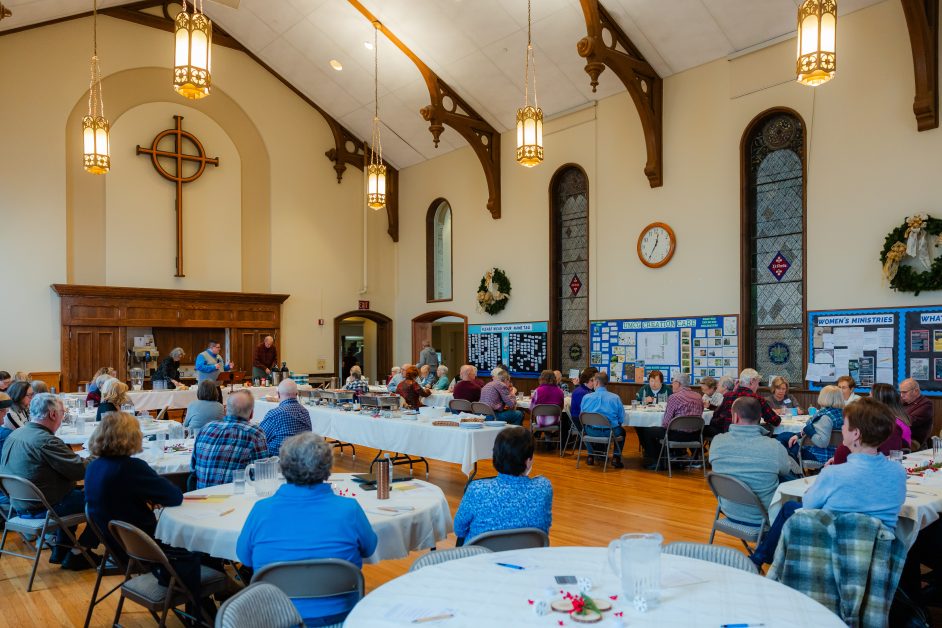
When I chose the date for our Foundations & Futures Luncheon on January 7, I knew from the start that not everyone who loves this church would be able to attend. That’s simply the reality of full calendars and faithful lives. So, if you weren’t there, please know this first: you were missed, you are valued, and the heart of what we shared belongs to you too.
Now earlier this week we shared part of what happened that afternoon: a first look at the 1874 Project. That work matters deeply. Caring for our building is essential to our witness, our accessibility, and our ability to serve generations to come. But as important as bricks and budgets are, we know they are not the whole story.
What I want to share here is the deeper conversation Pastor Heather and I offered that day. The vision shaping 2026 and the near-term future of United Methodist Church of Geneva.
Early in the luncheon, I offered a reminder that anchors everything else: the church is not a building, it’s a people. Even as we tend to sinking floors, systems, and long-range plans, our shared calling remains the same to love God, love neighbor, and the planet, doing so illuminates our communities with God’s grace.
To help ground that vision, I read from Luke 15—the story we often call the Prodigal Son. As the younger son makes his way home, something extraordinary happens. The father doesn’t wait. He doesn’t demand a speech. He doesn’t keep score. He runs to meet him. And the question that stopped us that afternoon was simple: How did the father see the son while he was still far off? Because he was looking outward.
That, I believe, is God’s posture toward the world. And it is the posture Jesus calls the church to take. Churches don’t usually drift outward by accident. There’s a gravity that pulls us inward—toward comfort, familiarity, and preservation. Resisting that pull takes intention, leadership, and practice.
This year, our Church Council is actively leading that culture shift from waiting to watching, from watching to running. Not just at the leadership level, but throughout the whole body. Because if we want to leave a future, we must keep reaching outward.
From Silos to Spirals
Pastor Heather then invited us to imagine how we live that calling together. They shared that for a long time, much of church ministry—here and across Protestantism—has been organized in silos. Children here. Youth there. Adults somewhere else. Those structures were created with good intentions, but over time they’ve often limited how faith is formed and shared.
Pastor Heather offered a different image: a spiral.
Faith doesn’t grow in straight lines. It grows in curves, returning again and again to core truths about God’s love, justice, grace, and belonging, but each time from a new place in life. That’s why they connected the spiral to a labyrinth—not a maze with dead ends, but a single winding path that sometimes draws us close to the center and sometimes stretches us toward the edge.
The edge isn’t where faith fails. It’s often where growth happens.
This vision invites us into intergenerational discipleship, where faith is formed not primarily through information, but through relationships and shared practices. Children, youth, adults, and elders walking the same path: learning from one another, worshiping together, serving together, and discovering that no one ever walks alone.
We’ve already seen glimpses of this through Grace, Gather, Grow and other moments when circles open wider and silos soften into shared journeys. This shift isn’t about abandoning age-specific ministry. It’s about weaving those ministries into a larger, more connected whole.
I also shared a clear-eyed look at our wider context. In Northern Illinois, the number of United Methodist churches is shrinking rapidly. Many are one large expense or one season away from closing. That’s the reality. And yet, UMCG is holding steadily. In a stable but aging community, we are welcoming people, sustaining ministry, and remaining outward facing. That matters more than it might seem.
In my conversations with leaders across the conference, two factors consistently determine whether churches survive and adapt:
- Clergy willing to lead beyond the walls
- Congregations willing to make space for new people and innovative ideas
By God’s grace, we are a church with both. That’s why I believe we are called not just to survive, but to become a resourcing church sharing what we’ve learned, equipping others, and strengthening the wider body of Christ. We already do this more than we realize.
The future before us is hopeful, but it will be more relational work than technical work. It begins simply: noticing people, saying hello, extending invitations, walking alongside one another.
Think for a moment about who helped you find your place here. Give thanks for them. They were looking outward for you, came to you, and helped you build relationships here and with Christ. And then remember it’s still our turn to do the same today.
These are the foundations we’re building, so that the futures God has planned—futures we can’t yet see—can take root and flourish.
Grace and peace,