Back in seminary, I was pretty focused. I wanted to finish in the standard three years, which meant electives were precious. I only had space for one elective in the New Testament and one in the Old Testament. So, when a new professor, Dr. Gambrell, offered his first class on the Psalms, my friends were excited.
Dr. Gamble was just a few years older than we were. He helped lead chapel, wrote prayers, designed worship, and had that rare combination of intellect and creativity that made him, well, kind of cool. A few friends encouraged me to take the class with them. I remember thinking, It’s just poetry. How hard can it be? I signed up.
What I discovered wasn’t “just poetry.” It was deep, abiding faith. It was resilient faith. Honest faith. Raw faith.
Over a semester immersed in the Psalms, I encountered prayers that stretched from the highest, most jubilant celebrations we have in life to the deepest, darkest despair we can ever face. There were songs of praise that practically danced off the page. There were laments that sounded like someone pounding on heaven’s door. There were confessions, thanksgivings, wisdom reflections, even psalms that wrestled with injustice and doubt.
The Psalms gave words to experiences I didn’t yet know how to name. They became, for me, the vocabulary of the soul. That’s part of what inspired this Lenten series.
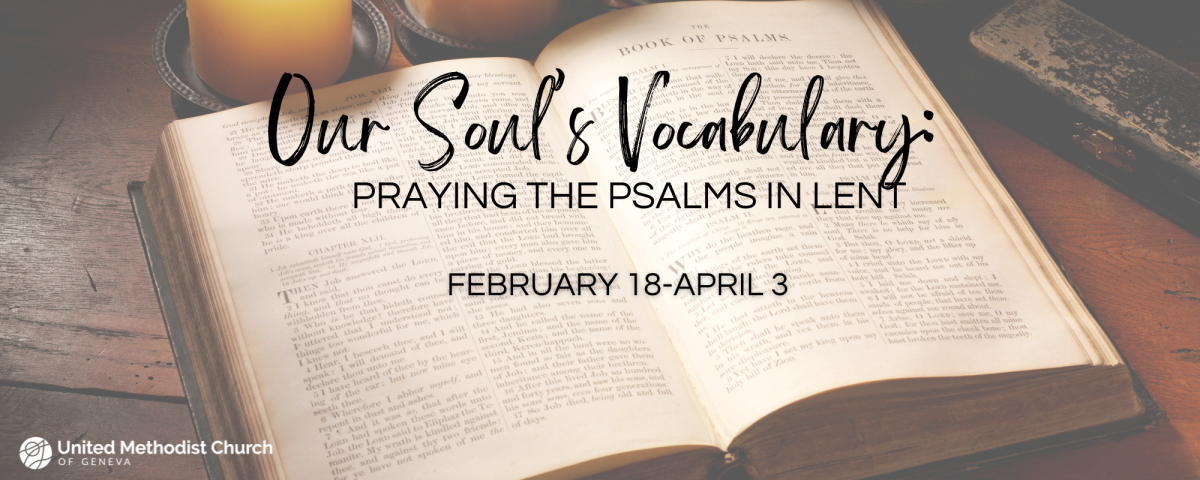
Late last summer, I did my annual congregational survey in preparation of my worship planning retreat. IN the results several strong themes emerged. First, many of us want to study a book of the Bible more deeply. Second, many of us want to understand the Psalms better. Lent felt like the perfect season to bring those desires together. So, this year, we are learning some of our soul’s vocabulary by praying the Psalms.
We already began on Ash Wednesday with Psalm 51, a psalm of confession. “Create in me a clean heart, O God.” That’s not polished religion. That’s a person who knows they’ve fallen short and still dares to ask for mercy.
In the weeks ahead, we’ll explore some of the major categories of the Psalms that beautifully fit the season of Lent:
- Lament – “How long, O Lord?” Honest cries when life feels unfair, painful, or unresolved.
- Trust – “The Lord is my shepherd.” Deep reliance on God even in shadowed valleys.
- Praise – Joy that overflows because God has been faithful.
- Thanksgiving – Gratitude after deliverance.
- Suffering and Hope – Prayers that hold pain and promise in the same breath.
We won’t cover all 150 Psalms, of course. But if we did, and if we read one psalm a day for the next five months, we would encounter poetry that confuses us, poetry that feels strangely familiar, poetry that sings deep within us, and poetry that finally gives us words for feelings we’ve struggled to articulate. There’s no catchy proverb like “an apple a day keeps the doctor away,” but maybe it’s something like this: A psalm a day gives the soul something to say.
The Psalms were originally songs. Many of them had musical directions and notes we’ve long since lost. Over the centuries, artists have painted them, composers have set them to music again and again, and communities of faith have prayed them in times of war and peace, plague and prosperity, birth and burial.
This Lent, we won’t just study the Psalms. We will experience them. On Sundays, instead of our usual single scripture reading, we will pray the psalm together responsively. We’ll use sung responses. We’ll let the rhythm and repetition shape us. We won’t just learn about the Psalms. We will pray them. We will sing them. We will let them give language to our lives.
And if you’d like to go even deeper, Pastor Heather will be leading a Lenten book study on The Heart of the Psalms by James C. Howell. Over six weeks, they’ll guide participants through six beloved psalms that speak of awe, beauty, mercy, trust, time, and love. The study will explore their historical setting, key Hebrew phrases, and the seasons of life they evoke. It’s a beautiful companion to our Sunday worship and another way to let the Psalms shape our prayer. The study meets Mondays during Lent, either in person at 11:00 am or via Zoom at 6:00 pm. Registration is required, and I hope many of us will take advantage of it.
The Psalms teach us that God can handle our anger, our confusion, our gratitude, and our joy. They remind us that faith doesn’t have to be tidy to be real. They show us that resilient faith is not the absence of struggle but the willingness to keep speaking, to keep singing, even in the dark.
I’m looking forward to this Lenten journey together. May these ancient prayers become our prayers. May they give vocabulary to what is stirring inside us. And may we discover again that God meets us in every word.
Looking forward to walking this road with you.