The week before last, Pastor Heather and I were strongly encouraged to attend the School of Leadership, a gathering of clergy from Wisconsin and Northern Illinois at Green Lake Conference Center in Wisconsin. More than 250 of us gathered for a few days of conversation around a deceptively simple question: How might we innovate for love? In other words, how might the church find new ways to share God’s love in the particular communities where God has planted us?
One of our exercises was to identify a need we see in our community, imagine a ministry response, and then workshop the idea with other clergy. Mine started with something that has been rattling around in my head for a couple of years.
Being a pastor sometimes means becoming an armchair sociologist. You pay attention to a community: how people live, what they value, where they struggle, what brings them together, and what pulls them apart. Then you look for places where the gifts and mission of the church might intersect with a real need.
Several years ago, UMCG identified improving mental health in our community as one of our goals. We knew immediately that we couldn’t do that alone. That’s why I’m so grateful for organizations like TriCity Family Services, Fox Valley Hands of Hope, Suicide Prevention Services, Mutual Ground, and others doing remarkable work around us as partners.
But one thing continues to concern me, especially when I think about our children and teenagers. Our community is incredibly competitive. Competition itself isn’t bad. Sports aren’t bad. Auditions aren’t bad. Excellence isn’t bad. Working hard to earn a place on a team can teach perseverance, discipline, and resilience. But what happens when children begin to feel as though they have to compete for belonging?
In many youth activities, demand is greater than the number of available spots. And it isn’t just athletics. It can happen in music, theater, art, dance, and other activities too. If you haven’t been developing a skill since you were very young, there may come a point when it feels almost impossible even to begin. A child tries out for one thing and doesn’t make it. Then another. Then another. Eventually, the message they may hear isn’t simply, “You didn’t make this team.” It can become, “There isn’t a place for me.” And when they finally do find a place, the pressure to keep it can become enormous because now that activity isn’t simply something they enjoy; it can become part of their identity and their sense of belonging.
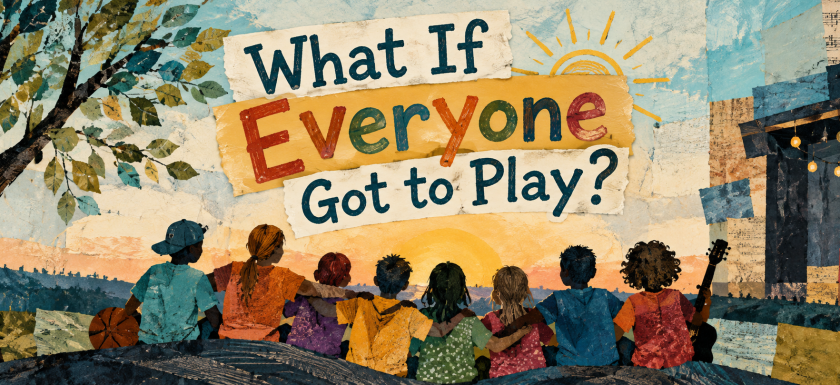
So here was the idea I brought to the workshop: What if there were youth activities where everyone got to play?
Not activities without excellence. Not activities where we pretend everyone has the same abilities. Not activities where nobody works hard. Something different. What if you still auditioned for the play but the audition helped us discover where you could contribute rather than whether you were allowed to participate? What if you still practiced the sport but the purpose was developing skills, learning teamwork, and accomplishing something together rather than competing for a limited number of roster spots? What if an experienced musician helped a beginner? What if the kid dreaming of Broadway helped the kid who needed extra help remembering a line? What if success wasn’t measured by who was best, but by whether we created something beautiful together?
This isn’t an entirely original idea. There are organizations already doing pieces of this. One theater program I learned about casts everyone who auditions. Sometimes that means roles are double-, triple-, or even quadruple-cast. Young people with very different abilities work alongside one another, helping each other learn lines, develop skills, and make the production successful. It’s unconventional. And I think it’s beautiful.
It also makes me dream a little about the space we’re creating through the 1874 Project. Our renovated Fellowship Hall is being redesigned so that moderate ball sports can happen there. We’ll have a stage for performances. We’ll have flexible spaces for art, music, gathering, and learning. What if, someday, each season included one activity for young people where the promise was simple: There is a place for you here.
At the workshop, someone naturally asked me, “So why can’t you just start this, you have the resources?” Because I know something after years of ministry at UMCG: our best ministries aren’t pastor-led.
Third Tuesday Supper wasn’t pastor-led. The Rummage Sale isn’t pastor-led. Our Swedish Days booth isn’t pastor-led. So many of the things that bring this congregation alive and make a difference in our community are pastor-supported, pastor-cheered, and pastor-participated-in but they are driven by people whose gifts, passions, and sense of calling bring them to life.
And I don’t have a group of people in mind for this one. Maybe that’s okay. Maybe my assignment coming home from the School of Leadership isn’t to launch another program. Maybe it’s simply to name something I see, share one possibility I can imagine, and then get out of the Spirit’s way. Maybe someone reading this is already thinking, I know exactly how we could do that. Maybe you’re thinking of something completely different and better. Maybe nothing comes of it at all.
But I keep coming back to that question: What if our church could create places where children and teenagers didn’t have to compete for belonging?
Would that solve the mental-health challenges facing young people in our community? Of course not. Could it make things a little better? I think it could. And could it be one small way of living into our mission—to illuminate our community with God’s grace as we lovingly accept, listen to, and serve all in the Spirit of Jesus? I think it just might.
So, for now, I’m simply putting the idea out there and trusting the Spirit with what happens next.
Grace and peace,