
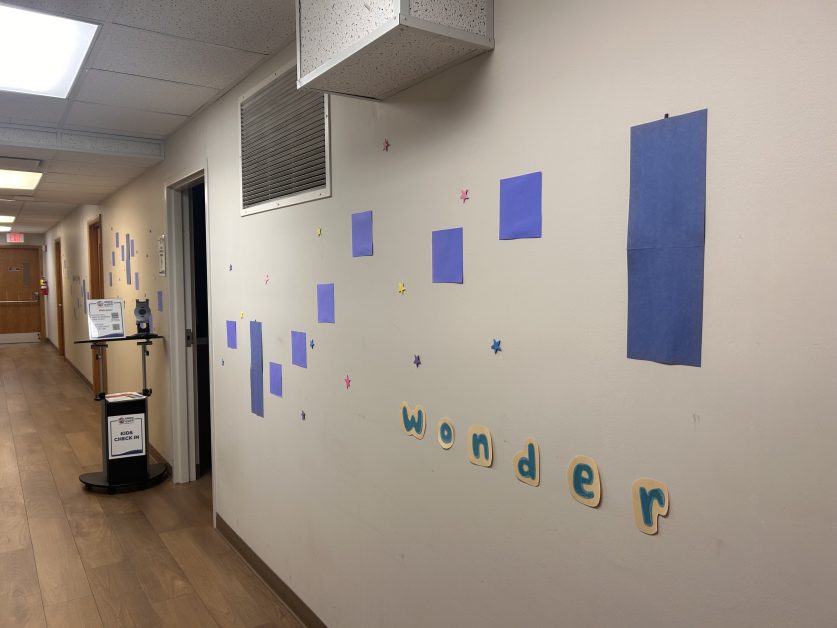
If you haven’t walked down the Children’s Hall lately, Advent is the perfect time to take a stroll after worship. Each week of the season, our kids are journeying through Waiting for Wonder, a four-week experience that invites them into Mary’s song, the Magnificat. This ancient hymn of hope, courage, and justice becomes our guiding light as children explore what it means for God to lift up the lowly, fill the hungry with good things, and scatter light in surprising places. The hallway itself has become a kind of pilgrimage path where each candle and each step of the path help them enter the wonder of Mary’s story in a way that is beautifully concrete…all the way to the manger.
On the first Sunday of Advent, the children “lit” their first candle on the wall. By this Sunday, they will notice the pathway we travelled during the week has changed…and they will “light” the second candle. By Christmas Eve, the hall will show how far we’ve journeyed in our waiting and shimmer with the light that marks the season. This weekly rhythm of “lighting” the hallway helps them experience the slow, hopeful movement of our church calendar and expands the visual of the Advent wreath in worship.
Why the Church Calendar Matters for Children (and grownups too!)
Whether we grew up with the church calendar or are encountering it for the first time, its seasons invite us into holy rhythms. For children, these rhythms do something quietly foundational: they create familiarity and belonging, especially when we pause to notice their cyclical movement together. Each color shift…each symbol…is a small anchor point in a world that can feel big and unpredictable. Children “read” the language of worship long before they have the words for it. They recognize the hopeful blue of Advent, the bright white of Christmas, and the turn of seasons marked by color and symbol. They notice the church dressed differently in Lent than in Eastertide, and they sense the meaning carried in a lit candle or a newly hung banner. Their eyes and bodies understand what the church year is saying even as their words are still growing. This kind of learning is formational. It teaches children the language of our faith long before they can describe it with words. In much the same way young children learn the rhythms of their home through bedtime routines, holiday traditions, the tone of a parent’s voice…they also learn the rhythms of church through colors, candles, quiet spaces, and shared songs. By carrying these cyclical rhythms into their spaces we are telling them, “You are a part of our church, this is your place too.”
Concrete Practices Make Room for Holy Wonder
The work we do on the Children’s Hall each week is intentionally hands-on. Moving through the liturgical seasons with children requires more than explanation…it requires touch, movement, and sensory experiences. “Lighting” a candle on the wall, looking for changes in artwork, putting together a Bible verse puzzle, changing the color of the cross drape, finding our spot on the church calendar, these tangible practices give children something to hold onto as they begin to explore deeper questions of faith.
When children are grounded in predictable rhythms and they feel comfortable with what to expect, they then can make room for questions that reach beyond the concrete:
I wonder…what does it mean for Jesus to be the Light? Why do we wait for something we can’t see yet? How do we know God is near? These are the big questions and children ask them naturally when they feel safe, welcomed, and rooted in familiar patterns. And sometimes our job as their guide is to wonder alongside them, with gentle spiritual nudging, instead of being quick to give an answer. To be okay with leaving space for wonder.
During Advent, as we return again and again to the theme Waiting for Wonder, we are helping children discover that faith is not something rushed. It is something grown and nurtured…one candle at a time, one story at a time, one practice at a time. Wonder takes root when there is spaciousness, when the environment and the rhythm invite them to slow down and notice.
A Hallway That Tells Our Story
This Advent, the Children’s Hall becomes a living classroom of sorts. It tells the story of Advent in a language children speak fluently: color, repetition, and movement. It also gives grownups a chance to step into the slow, attentive spirit of the season. When you walk down that hallway, you’re seeing not just decorations but a glimpse of how faith is forming in our youngest members.
So, this Advent, I hope you’ll take a moment after worship to wander down the Children’s Hall. Pause by the candles. Notice how the pathway changes week by week. Allow yourself to feel the excited anticipation that our children experience so naturally.
We are all, in our own ways, waiting for wonder. And sometimes the youngest among us are the best guides.