Public domain (published before January 1, 1931; public domain in both the United States and Argentina).
Source: Wikimedia Commons.
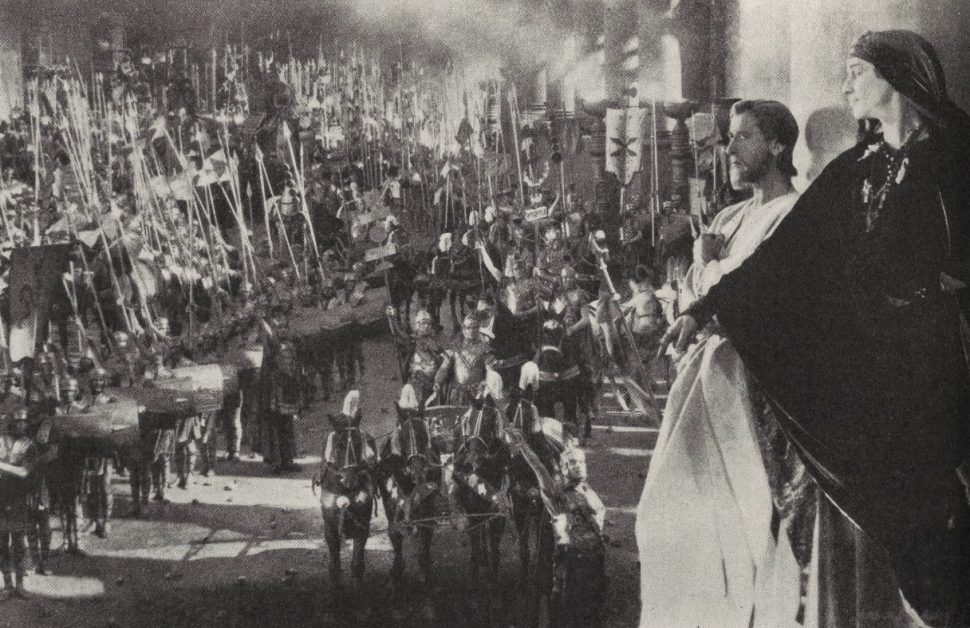
A nearly century-old portrayal of Jesus’ kingship from Cecil B. DeMille’s silent film King of kings, already pointing toward the paradox at the heart of Christian confession: that the King of kings reigns from a cross.
Recently our worship planning team gathered around the zoom screen to dream about Holy Week and Easter. There were calendars and hymnals, half-formed ideas and bold ones. We asked the usual questions, how might this idea work? How might this year be experiential, not just something we watch but something we step into?
Spoiler alert: it’s going to be very experiential this year. And here’s the double spoiler, we’re ending Easter morning singing the Hallelujah Chorus with choir, organ, and string quartet!
I love that one. It’s a favorite for many of us. When I was growing up, my home church sang it a few Easters. I can still see the sanctuary, still feel the nervous energy of being a budding tenor in our little church choir, trying to hold my part while the organ swelled and the sopranos soared. Rehearsal after rehearsal, we sang those words: King of kings and Lord of lords.
At the time, I’m not sure I fully understood what I was proclaiming, but the question stuck with me: what does it mean to say that Jesus is King? What does it mean to call him Lord? That question followed me into seminary.
One of my favorite courses was taught by a 90-year-old rabbi adjunct professor. Mostly, we sat around and asked him questions. Everyone loved the class, in part because there was hardly any reading. But it wasn’t the lack of reading that made it unforgettable. It was him. At one point he said something that lodged itself deep in me. He said that in America we have no idea how different our experience is from much of the rest of the world. Even at our worst, he said, we are largely spared what it means to live under a ruler, where not just individuals but an entire society is shaped by the will of one person, one family, or one ruling party. He was right. For all our political tensions and cultural divides, most of us have never known what it is to wake up under the unquestioned authority of a single king. We don’t instinctively understand what it means to say someone reigns.
Ever since that class, I’ve tried to wrap my mind around how different that makes our reading of Scripture. When the early Christians proclaimed that Jesus is Lord, they were not offering a private spiritual preference. They were making a public claim about reality itself. Lately, that question has been stirred up again.
Since that worship meeting, I keep seeing the kingship of Jesus everywhere. It’s showing up in my devotions. It’s echoing in the news. It’s in my playlists. There’s even another “no-king” march scheduled for the Saturday before Palm Sunday this year. I couldn’t help but notice the irony. It was on Palm Sunday that Jesus was welcomed as a king, branches waving, voices shouting, but I digress.
This morning, March 2, my devotional reading felt like it was written just for this moment. From Eugene Peterson’s God’s Message for Each Day, a gift I received from Marie MacKenzie in memory of Denny Duszak, came these words: “Finally, to make sure no one missed the point, he arranged that his coronation take place on a cross.” A coronation on a cross.
If we are honest, that is not how kings behave. Kings consolidate power. They defend territory. They eliminate threats. They rule by force, fear, or at least by leverage. But Jesus refused the devil’s offer of political authority. He rebuked the impulse to call down fire on enemies. He told Peter to put away the sword. He assured Pilate that his governorship was not under threat. And then he chose a cross as his throne. That is a different kind of King!
I’m not sure I will ever fully grasp how different our American experience is from most of human history. I don’t take for granted the freedoms we enjoy. But instead of becoming a social studies expert, I’ve tried to stay in my lane as a theologian. I spend my time wondering how Jesus could be so utterly unlike every ruler the world has known and yet endure. Empires have risen and fallen. Parties have gained and lost power. Names once feared are now footnotes in history books. And yet we still sing.
We still stand when the first notes of the Hallelujah Chorus ring out. We still dare to proclaim that this crucified and risen one is King of kings and Lord of lords. I admit there is something foolish about it. Risky, even. To bow one’s head and heart to a king whose crown was made of thorns. To align one’s life not with the loudest voice or the strongest fist, but with the one who washed feet and forgave enemies. But I don’t know of any reign that has outlasted his. I don’t know of any rule that has brought so much light into so much darkness, so much life into so many corners of death.
So, each morning, in quiet, and often before anyone else is awake, I bow my head and heart to my King and my Lord, Jesus. Not as an escape from the world, but as a way of living in it. Not to seize power, but to be shaped by love. And this Easter, when we sing those words again, I will remember the young tenor who first tried to make sense of them.
King of kings. Lord of lords. Still reigning.