
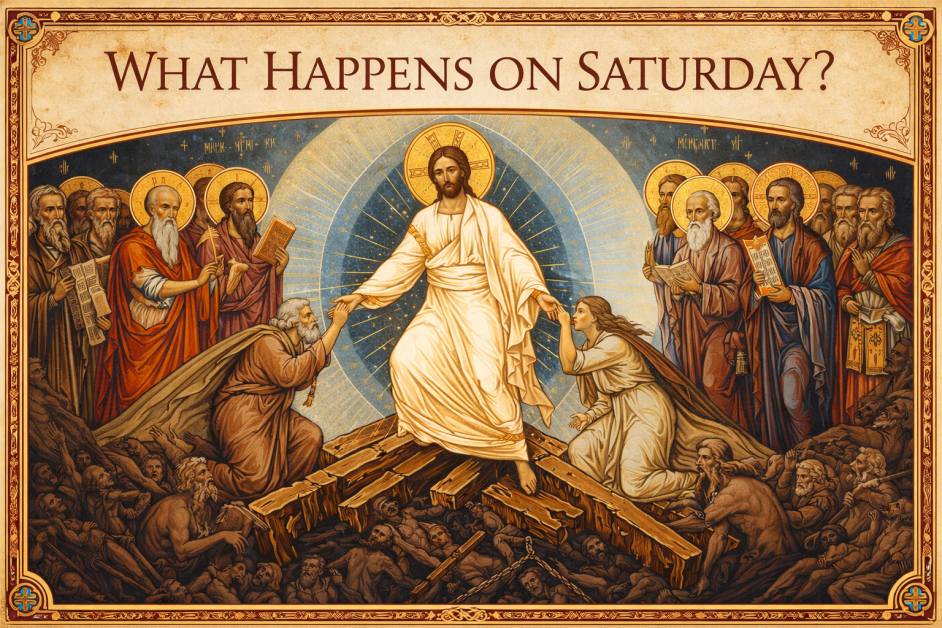
Every couple of years, I find myself coming back to this question. ‘What Happens on Holy Saturday?’ The day between Good Friday and Easter.
At our house, we kind of joke that I’ve turned Holy Saturday into “project day.” I’m out in the yard or fixing something. Maybe I’m changing light fixtures or changing the oil. Whatever it is, I’m mostly keeping busy, distracting myself from the pressure of Easter morning. And this year will barely be different. We’ll be with my extended family and packing to head out of town, getting ready to travel to Mississippi to help a friend with bereavement work next week. There’s always something to do.
And maybe that’s part of why Holy Saturday matters so much. Because while we keep moving the Church dares to say that something unseen, something profound, is happening. Scripture doesn’t give us a detailed play-by-play of Holy Saturday. But it gives us hints.
- “He descended to the dead.” — Apostles’ Creed
- “He went and made a proclamation to the spirits in prison.” — 1 Peter 3:19
- “When he ascended on high… he also descended to the lower parts of the earth.” — Ephesians 4:8–9
From these glimpses, the Christian tradition—especially in the early Church—began to tell a bold and hopeful story. That on Holy Saturday, Jesus did not simply lie still in a tomb. Instead, Jesus entered death fully and then went deeper still. Into the realm of the dead.
Christians have long called this moment the Harrowing of Hell. Not “harrowing” as in scary, thrasher movie, but as in plundering. You know, breaking in and setting captives free. In icon after icon, painting after painting, we see the same kind of image: Jesus standing over shattered gates or doors, broken off their hinges. Beneath his feet, the doors of death splintered and crushed and in his hand’s humans, perhaps Adam and Eve, the first ones the representatives of all humanity. They are being led out, and the gate remains open for any who want to follow Jesus out.
The story the tradition of the Church tells is this: Jesus did not just die. Jesus went to be with the dead. The lost. The forgotten. The long-gone. And even there, no, especially there, God was still at work.
We often think of this day as quiet or still. But the tradition suggests something else entirely. Holy Saturday is not a day of rest. It is a day of rescue. While the world waits and the disciples grieve and everything feels finished God is still moving, still working, still saving and not even death can stop that.
Now, to be clear all of this isn’t a fully spelled-out biblical narrative. This is where we lean into what we call, in the Wesleyan Quadrilateral, tradition. Scripture gives us the edges. Tradition fills in the picture. And what it paints is a God who refuses to abandon anyone, not even in death.
Maybe Holy Saturday hits differently because it feels familiar. It’s the in-between space. The place where we know that grief is real and hope hasn’t fully arrived and we don’t yet see how resurrection is possible. And in that space, the Church whispers: God is still working, even in the places that feel like endings.
So, if Holy Saturday finds us busy—preparing meals, traveling, cleaning, setting up egg hunts, finding the perfect outfit, getting ready for guests—that’s okay. Maybe even fitting. Because while we are doing our small, ordinary work God is doing something deeper. Something unseen. Something that reaches even into death itself and says: You don’t get the final word.
So whatever work fills your Holy Saturday whether it’s joyful, stressful, exhausting, or sacred in its own quiet way may it somehow connect us to the deeper work Christ is doing. The work of bringing life out of death. Hope out of despair. Resurrection out of what feels finished. And may we carry that with us into Easter morning.

P.S – I am super excited about Easter worship this year. Our 9:00 a.m. worship is going to be something special: beautiful music from our choir, organ, and a string quartet, communion, and even a little pop quiz in the sermon. We’re going to see if we can spot AI fakes or not. Which feels oddly appropriate in a season all about truth breaking through what looks real but isn’t.
If Holy Saturday is the in-between, then Easter is the moment when everything comes into the light.
Think of someone: a friend, a neighbor, a family member who might need a little hope right now. Someone who might be living in their own kind of Saturday. And invite them to come sit with you. No pressure. No perfect words needed. Just an honest, “Hey, want to come with me?” I’d love for you and someone you care about to share in worship this Easter morning.