I think it was about three years ago that large language models like ChatGPT entered the mainstream conversation. Mostly for fun, I asked one AI model to write a church blog about Lent.
What came back was…fine. At its best, it was a middle-school one-page paper on Lent. It knew what Lent was. It could string together some inspiring thoughts. It sounded vaguely churchy. But it didn’t really say anything about what Lent meant for us. I remember thinking, “Well, this is interesting, but I’m not too worried about it taking my job.” A lot has changed in three years.
Today, I use AI nearly every day. And I do that even as I have real concerns about its environmental impact, privacy, and some of the larger ethical questions surrounding this technology.
The best way I can explain how I use AI is to imagine that it’s 1960. If our had the resources then that it provides today, I might have had an executive assistant. Let’s call them, Edna.
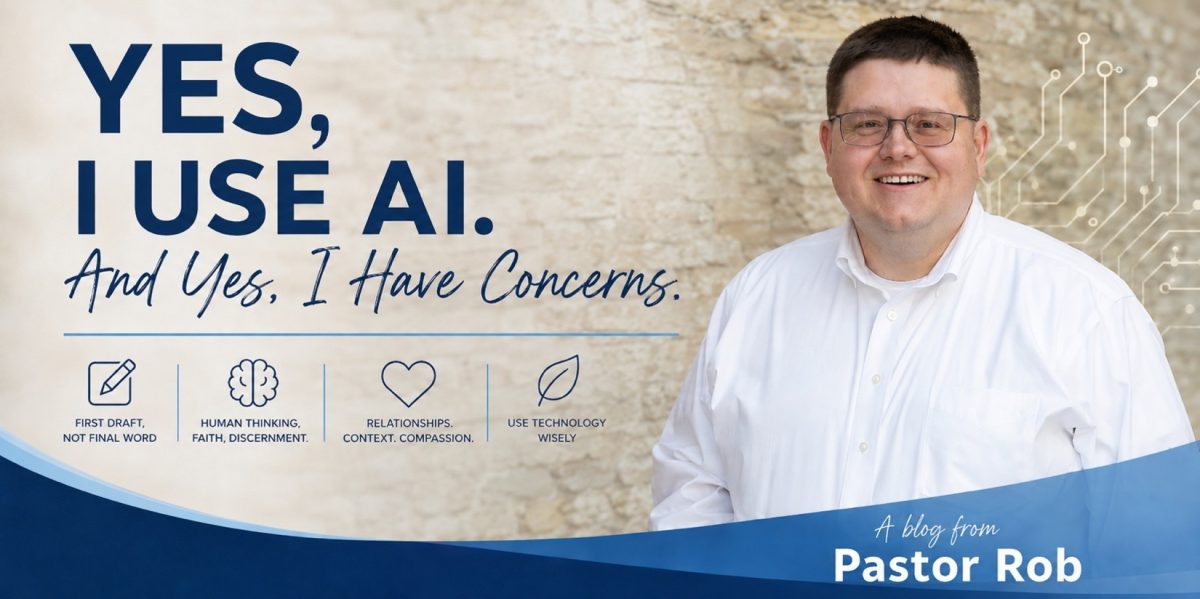
After working with me for ten years, Edna would know me pretty well. I could walk into their office and say, “Edna, I need to send a letter to the congregation about such-and-such.” They would know how I write, how I talk, what I tend to emphasize, and probably even the phrases I overuse. They might bring me a draft that sounded remarkably like me. I’d mark it up, change a few things, hand it back, and eventually it would go out. That’s pretty close to how I use AI. In fact, I’m using AI to help write this article right now and it made the graphic at the top and it saved me about 50 minutes’ worth of time.
Often, I simply dictate my thoughts—sometimes rather messily—give AI some context, and ask it to turn them into a first draft. Then I revise. I add things. I delete things. I tell it, “That doesn’t sound like me.” Sometimes I tell it to make something less polished because it has cleaned up my words so much that I can no longer hear myself in them.
I use it similarly with email. It is often much easier for me to dictate what I want to say and let AI help with the formalities, organization, or tone. And because I have nearly twenty years of sermons, articles, letters, and other writing to draw from, I can give AI plenty of examples of how I actually communicate.
It helps with smaller things too. Those discussion questions at the end of our Sunday bulletin? I usually give AI my sermon and ask for possible questions for children, teenagers, and adults. Then I choose and edit the ones that best fit. Sometimes a sermon is too long and I ask where I can tighten it. Sometimes I don’t know how to end a sermon, so I ask for several possibilities—not necessarily because I’ll use one (though sometimes I do), but because seeing them helps stir my own thinking. It’s not that different from phoning a friend when I’m stuck. But there is an important distinction: AI is usually my first draft, not my final word.
And I am increasingly grateful that I encountered this technology after developing my own critical-thinking skills and theological foundation. AI can produce something that sounds remarkably confident and still be wrong. It can take all the material I give it and somehow miss the point. It can write something technically excellent that simply doesn’t hold up to theological scrutiny or doesn’t understand the people who will actually hear it. That part remains deeply human.
Before something goes out under my name, I still need to think, pray, revise, struggle with it, and ultimately take responsibility for it.
I’ll even admit that sometimes AI writes a better prayer than I do. It has access to a breadth of poetic language that exceeds my own. That can be a gift. But it doesn’t know the person sitting across from me at the bedside. It doesn’t know our congregation the way we know one another. It cannot replace relationships, context, judgment, compassion, or the work of actually living a life of faith together.
And yes, I have concerns. I worry about the resources required to power AI. I worry about privacy, which is why I remove identifying or sensitive information when I use it to help with correspondence and add those details back myself. I worry about what happens when we stop developing our own skills because a machine can do something faster. I don’t have all those questions resolved. Maybe that is part of living through any major technological change: learning how to receive what is genuinely useful without pretending there are no costs.
So yes, your pastor uses AI. Quite a bit, actually. I find it extraordinarily useful. I also think we should approach it thoughtfully, critically, and perhaps even a little prayerfully.
I’m curious about you. Do you use AI? What do you use it for? What excites you about it—and what worries you? I’m always interested in learning.
Take care and God bless,